


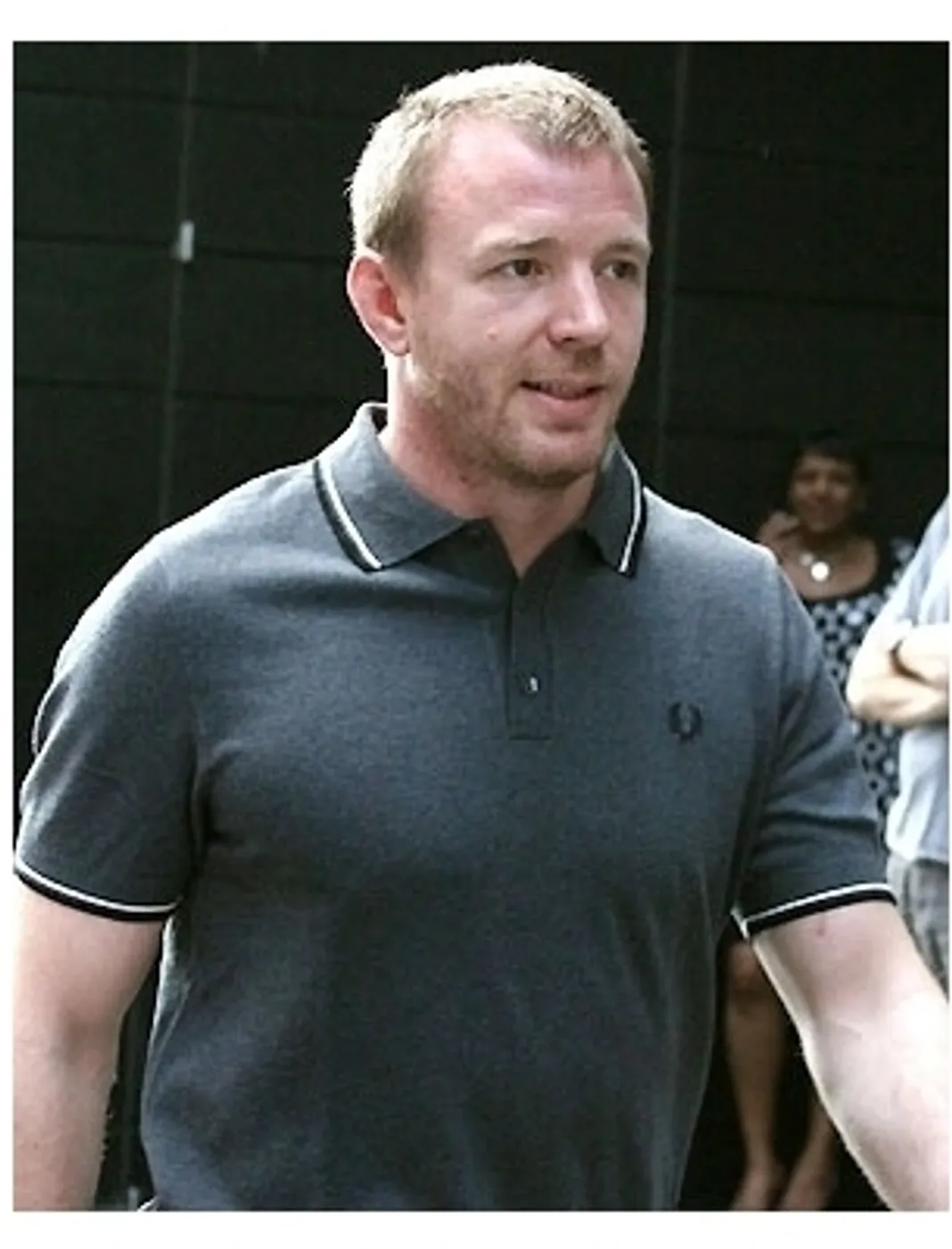

After a summer of media speculation about his marriage to Madonna, Guy Ritchie assured his fans that everything is fine. “As far as I’m aware of,” he coolly responds to a media query. Ritchie makes a public appearance at San Diego’s Comic-Con to show footage of his upcoming movie RocknRolla–another Ritchie gangster movie in the vein of Snatch and Lock, Stock and Two Smoking Barrels about a stolen painting which pits some of the city’s scrappiest tough guys (Gerard Butler, Idris Elba) against London’s more established underworld players. An odd choice for a Comic Con splash, but apparently, comic-book readers like Ritchie‘s British gangster movies as much as they do their superheroes.
Hollywood.com: Why does this genre click with you so much?
Guy Ritchie:
I don’t know. I just like under cultures and subcultures. It just happens to be my thing.
HW: What was your inspiration for RocknRolla?
GR:
Well, the thing is, it’s in the same genre as Snatch and Lock Stock and I felt I wanted to do another one, partly because of the amount of enthusiasm I got from those movies, but also because England’s changed so much in the last 15-20 years. Part of the movie is about old-school gangsters getting pushed out by the new school by the Eastern Europeans or Russians. So a few years ago, if your average gangster had made a few million pounds and was seen as a big to-do, that’s really been eclipsed by the international Eastern gangster who now comes packing billions. This is, to a degree, a reflection of the old school natives trying to hang on to business as it used to be but they’re just being pushed out by corporate massive crime–and by corporate, I mean in a purely criminal sense.
HW: Is it important to you to keep exploring contemporary London?
GR:
Well, I’ve used the word exponential and I think it’s pertinent toward culture in general, and particularly any capital that moves as fast as New York or London is that the time and space, technology is a reduction of time and space and motion. It’s done that to culture, too, so everything is moving exponentially, so fast that we can’t keep tabs on it. So I suppose this is the interesting part just before it completely goes off the Richter scale in terms of its pace of changing. This is like a documentary of before we can’t recognize it at all for the identity it once had.
HW: Are you still a fan of London?
GR:
That’s me home town, yeah. I was born there and I’ve seen it change and I know a great deal about it, I’m invested. I live vicariously through my wife so I was once a spy and now I’ve become a tourist and it’s much more fun to live in London as a tourist than it is as a spy. Someone told me the definition was a spy always looks for the bad stuff and a tourist always looks for the good stuff. So that makes it easy, being married to an American.
HW: What are the social commentaries in RocknRolla?
GR:
Sure, the social commentary is everything I’ve been talking about. I mean, the social commentary is how the face of England, I suppose in turn, England is no longer has the identity that we previously understood it to have. It’s become international like New York has become international. So the commentary is how I suppose identities have shifted, cultural identities have shifted. If you take New York and London now, they’re so much more similar than they used to be. It’s commentary on that. It’s commentary on how crime has shifted. It’s commentary on how business is conducted. Previously people could offer, let’s say take an example of a million pounds for a house, and then an oligarch will come along and would say, “Just to take it off the market and to save and haggling, I’ll offer you 20 million.” That wasn’t necessarily uncommon. It suddenly became, “It’s going for a million, well, I’ll offer two, three.” Then you just go, “Oh, f**k it. How much do you want for it? Here’s 20 million.” Now they did that with football teams. They did it with football players. They did it with every sort of cultural manifestation that we had, these exponential bid would suddenly come into the equation. That had tremendous cultural effect on the way everything was manifest. So we try to reflect some of that within the movie too.
HW: As you get older, do you approach criminals with a less romantic perspective?
GR:
Probably not. It’s pretty much I think an objective view of crime on the whole. I try not to be ethical or moral about it. It’s simply an observation and commentary on that observation. That sounded relatively intellectual.
HW: Have you ever met any criminal elements?
GR:
Absolutely not. I refuse [to associate with them]. The criminal underbelly of society is heavily frowned upon by myself. [Laughs]
HW: Do they ever want to get involved and give you notes on your scripts?
GR:
Yes. I mean, the idea, many of the ideas, the pig-feeding story, for example, in Snatch, if anyone is familiar with it, that’s a cliché of how people dispose of bodies. Since then I’ve seen it pop up in several movies, but yeah, I had met the guy that used to remove the teeth before they chopped the bodies up and fed them to the pigs. By the way, now he’s a grandfather, he’s a lovely chap, he gives to charity, he runs his local football team and he looks like your average avuncular generous individual. So sometimes there’s nothing exotic about the exoticism of crime. That’s kind of interesting in itself, that sometimes people can do what we see as heinous and nefarious acts and to them it’s just par for the course.
HW: Revolver was met with some confusion and resistance at first. Has it been re-discovered on its metaphysical levels now?
GR:
That’s a highfalutin question. I don’t know. You probably know better than I. I always knew it could be a tricky sell purely because of its ambition, but it’s exactly the movie I set out to make and it’s the movie that I’m happy with but it’s going to divide opinions certainly. By its very definition, that’s what it’s designed to do.
HW: Are audiences harder to surprise with twists and turns now that they’ve seen your earlier films?
GR:
I think it depends on what genre I’m going into. The movie after this, we’re doing Sherlock Holmes and that is clearly going to be in a different genre, right? So I think people would expect something very different and hopefully a flavor of what it is they are familiar with. This was clear in the fact that it did what it said on the tin. I was interested in this genre that people are familiar with and as I say, I hope it’s got enough stuff in it, new nutrition, to inspire an audience.
HW: How different is your Sherlock Holmes going to be?
GR:
It’s going to be very contemporary. It still remains in its period but we like the idea that he’s an intellectual action guy to a degree.I mean, I suppose originally Sherlock Holmes was this intellectual action man and I think what happened was they played down the action-man aspect because they just didn’t have the means of executing the action in interesting ways. Well, we do have the means and we have the technology so we’re just riding on the back of that.
