



Aaron Eckhart and Alan Ball are both having quite a year. Eckhart stars in the biggest summer blockbuster to grace the screens in awhile, The Dark Knight, while writer/director Ball has launched a new HBO show True Blood to great reviews.
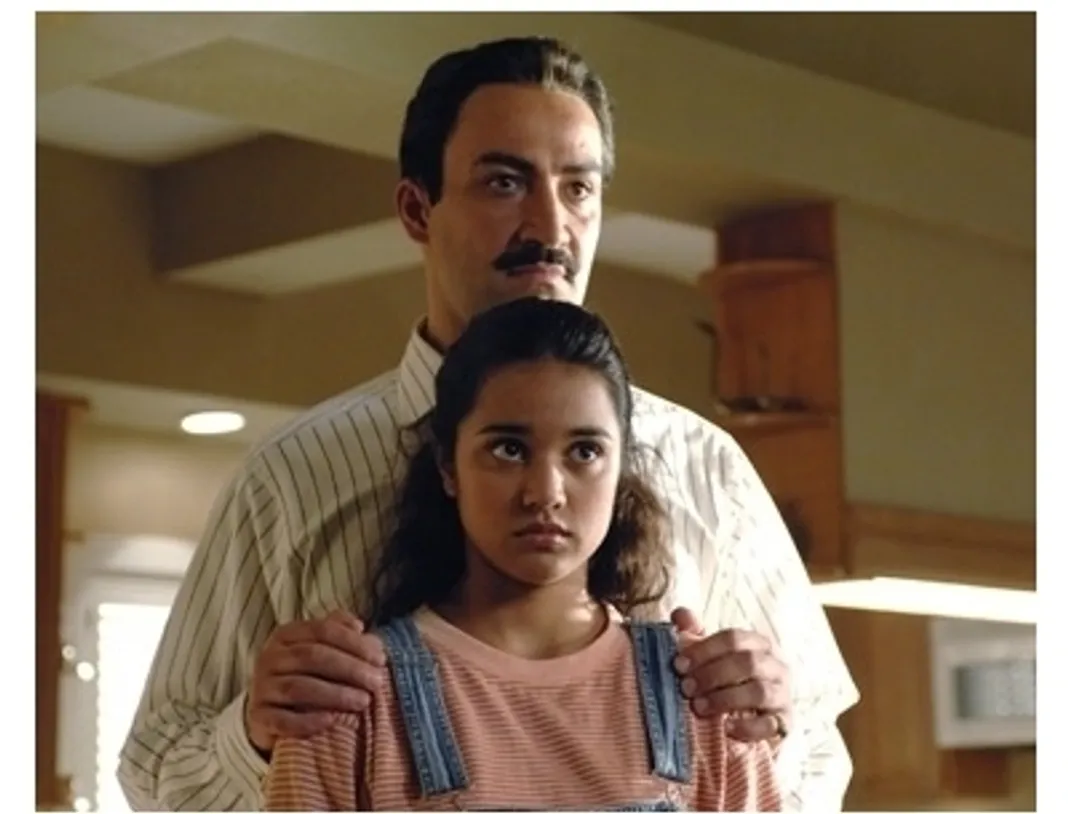
Yet, before all that, the two of them worked on Towelhead, a film based on a novel by Alicia Erian about a 13 year-old Arab-American girl named Jasira (Summer Bishil), who is awakened sexually as she enters puberty–but ends up attracting the unsavory attention of her neighbor (Eckhart), a married man going through his own mid-life crisis. Yeah, kind of touchy stuff, but Ball, making his feature film directorial debut, manages to handle the subject matter with a steady hand, even if his leading man had issues with the role.
Hollywood.com: How did you approach Mr. Vuoso?
Aaron Eckhart:
Well, I tried to make him a human being and have him try to fall in love with Jasira. That was the only way that I could do the movie. I mean, the movie with Alan [Ball] directing it, obviously, and writing it and Summer’s [Bishil] and Peter [Macdissi], all the wonderful performances in it, but just the subject matter for everybody, even Summer, is just a little bit…for me it was tough because it was a 13 year-old girl. If it had been any other thing…for an audience to see that, and especially coming off of The Dark Knight, which you have to think about and now they go see me with a 13 year-old girl is interesting.
HW: Well, you didn’t plan the timing on this, I’m sure.
Eckhart:
No. No, I didn’t. And then physically actually going to work and doing the scenes, that was a little bit difficult. Travis is unhappy at home, he’s unfulfilled in his life. He’s at a dead end and is living a black and white existence, and then she’s just this color with a vibrancy to all the senses and the music of love. He sees a way out and his youth is reignited in himself and he becomes a kid again.
Eckhart continues: One thing is that Travis found himself in this situation. She moved next door and baby-sat his kids. It’s not like he was out there on the prowl which again made it more palatable, but nevertheless he made the choices. But I think that’s another thing. It’s human that these forces come over us and we can’t shake them until we do the thing. I’m not just talking about sex, but I’m talking about all our sort of addictions or whatever we have in life. We see it all the time in all parts of the world and in our lives and in society. That’s why therapists are there. I think that Travis is basically a good guy. He’s sort of a dumbshit really when it comes down to it
Alan Ball: It’s uncomfortable. It’s a very uncomfortable experience. When I read Alicia’s [Erian] book, that’s the experience I had. The characters are so real, and I was horrified by what was happening, but at the same time it was hilarious and eventually as I got towards the end of the book, I was thinking, “Oh, no. This is not going to be good. This is not going to turn out good.” Then it did, and I felt such relief and such authentic joy. I felt really hopeful and optimistic. I thought, “Wow. That is no small feat.” I could see the movie version of it that would hopefully do exactly the same thing. I got on the phone with Alicia. I told her everything that I loved about her book and I said, “I promise you that I’ll keep it funny because it is funny and I think that’s an important part of it.”
HW: How did you and Summer Bashil approach those scenes together?
Eckhart:
Well, Alan really created a good atmosphere of trust on the set. Summer just had a great time making the movie. She and Peter [Macdissi, as Jasira’s father] got along so well and really had like a father/daughter relationship. For us, it was more mechanical. It was like, “I’m going to do this. Then I’m going to do this.” It was important, I think, for her, but I think it was more important for me because then I felt like it was OK.
HW: What were some of the things that you wanted to concentrate on when you made it?
Ball:
I wanted to concentrate on the fact that it’s a common experience. It’s not an experience that always falls into the sort of paradigm of innocent victim/subhuman predator, which is the way that story is usually told. It doesn’t have to result in lifelong victimization. People who do bad things are still people, humans, and they’re still capable of being a part of something good, but it is a crime. It’s a crime legally and it’s a crime spiritually. You cannot hold a child accountable to the same standards that you hold an adult accountable to. Even if a child is provocative it doesn’t make them deserve what happens to them.
Eckhart: Yeah. This is a brave movie. I mean, the whole thing in terms of Jasira coming into her womanhood and everything that entails and all that sort of stuff, that’s stuff that’s awkward for me to talk about or even watch.
HW: Working with Summer, how did you help her approach some of the things that she had to do?
Ball:
She’s very, very self-possessed and a sophisticated young woman. She grew up in Bahrain. I remember at one point I asked her during filming, I said, “Summer, what do you want to do after doing this?” I thought she’d say, “Well, I’d like to keep making movies.” She said, “Well, I want to go to school and get a degree in International Relations and then I want to go back to Bahrain and open a home for the homeless because there’s a big homeless problem in Bahrain.” I was sort of like, “Wow. When I was 18 I just wanted to get high and go to the beach. I’m totally intimidated by you.” So basically we were very respectful. Her mom was there every day. We had a body double when necessary, but she knew what she was doing. She knew what was expected of her and I think she thought, “Wow, this is a role of a lifetime.” I’ve worked in situations where actresses have been over in the corner crying when they’ve been asked to do much less. I kind of expected that and that wasn’t the case at all. She’s really a trooper, really a pro. It was much harder for Aaron.
HW: What are you hoping that audiences are going to take away from this when they see the movie?
Ball:
I’m hoping that they’ll take away the things that I took away from the book, that you don’t have to be a victim. You don’t have to do things that you don’t want to because you’re a female and you think that’s what people expect of you, that ultimately you control your own body and your own life. Racism is ridiculous no matter where it’s coming from. That there’s hope and that we can heal. That’s what I got from the book and I feel like that’s what I wanted to transfer to the different medium of the screen.
